

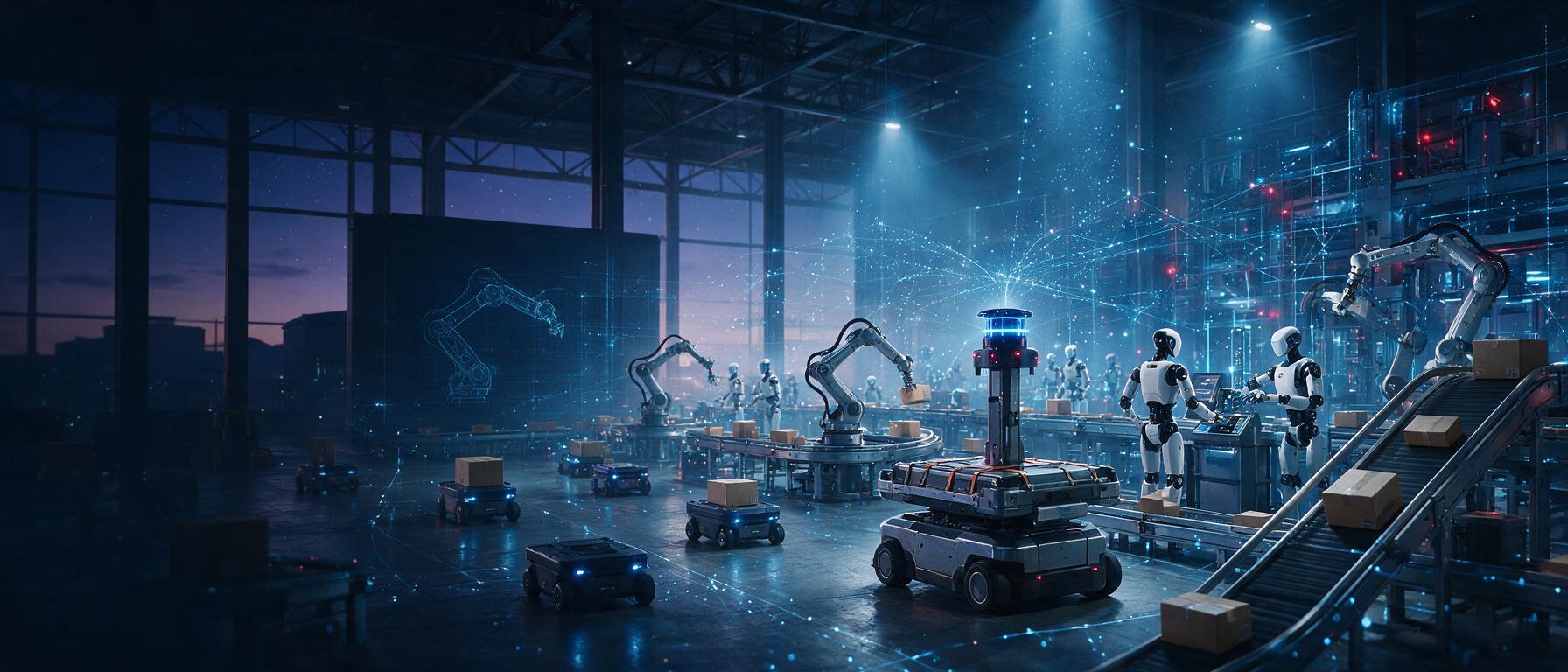
JD.com recently unveiled a three-part Physical AI strategy at the JDD Conference: an open-source world model, a plan for a 100,000-GPU domestic compute cluster, and the procurement of 3 million robots over the next five years.

These three initiatives span four critical layers of the Physical AI stack: compute as the foundation, data as the fuel, models as the engine, and robots as the body.
JD.com’s strategy is to go deeper into the physical world rather than simply compete on raw compute scale. Instead of chasing the biggest infrastructure footprint, it is betting on something potentially more valuable: real-world applications and operational scenarios.
JoyAI-Echo WM: An Open-Source World Model That Tops the Benchmark
JD.com has released and open-sourced JoyAI-Echo WM, a real-time, interactive world model designed to understand and interact with dynamic environments.
On WBench Navigation, a public benchmark for interactive world models, JoyAI-Echo WM achieved a score of 81.6, ranking first.
JD.com has also open-sourced JoyAI-VL-Interaction, a multimodal model designed for real-time interaction. In a blind human evaluation across 58 streaming scenarios, the model achieved a 77.6% win rate against Doubao and an 87.9% win rate against Gemini.
Together, these releases form part of JD.com’s growing JoyAI foundation-model portfolio, spanning multimodal models, world models, and embodied AI models.
100,000 Domestic GPUs + 10 Million Hours of Real-World Data
On the compute side, JD Cloud has partnered with a domestic GPU company to build a large-scale cluster with thousands of GPUs and is planning a 100,000-GPU cluster.
At the same time, JD.com is working toward collecting 10 million hours of video data from real-world human activities, covering the entire pipeline from data acquisition and storage to annotation, training, evaluation, simulation, and testing.
Its first open-source dataset, EgoLive, is already available. More than 100 universities and research institutions across over eight countries have applied to use the dataset.
JD Logistics’ Zhilian “Super Brain” Large Model 3.0 provides an early example of how this infrastructure can translate into operational value. The system has reduced route planning for hundreds of millions of packages from a minute-scale process to seconds, while its embodied intelligence model has achieved a 96.7% task success rate across multiple scenarios.
3 Million Robots and 80 RoboBases
On the hardware side, JD Logistics plans to procure 3 million robots, 1 million autonomous vehicles, and 100,000 drones over the next five years, while establishing more than 80 RoboBase robotics industrial hubs.
Six robots from its “Wolf” series were unveiled at the conference, covering applications ranging from pharmacy operations and cold-chain logistics to last-mile delivery.
JD.com’s Differentiated Approach
JD.com is not trying to win the race for sheer compute scale.
Huawei Ascend, for example, has reportedly commercialized more than 750 384-node superpods, while Baidu’s Kunlunxin has expanded its infrastructure to 32,000 GPUs.
JD.com is pursuing a different path: positioning itself as a “global Physical AI operations center.”
The distinction is straightforward:
Others compete on model parameters; JD.com competes on packages.
Others primarily rely on internet-scale data; JD.com has access to data generated inside warehouses, delivery stations, stores, and other physical operations.
Because JD.com operates its own warehouses, delivery infrastructure, and retail network, it can validate AI systems in its own operating environment before potentially exporting those capabilities to external customers and industries.
Its “Super Brain” was born out of logistics. Its world model is being shaped by the need for simulation and interaction in real-world environments.
For cloud providers, model performance is often expressed through parameters and benchmark scores. For JD.com, the more tangible metric is the 96.7% task success rate recorded in actual business scenarios.
Conclusion
JD.com is entering the Physical AI race in a way that differs from the conventional playbook of China’s major technology companies.
Rather than manufacturing its own chips or competing directly for compute rankings, JD.com is turning its warehouses, delivery stations, retail network, and production environments into real-world training grounds for AI.
Its data, models, and robotic systems are still being validated, and whether the entire strategy can be executed at scale will ultimately depend on the operational performance of the planned 100,000-GPU infrastructure and the real-world return on investment from deploying 3 million machines.
But JD.com is making a broader point about the emerging Physical AI landscape:
In the age of Physical AI, the physical world itself—and the real-world scenarios in which AI can be trained, tested, and deployed—may be the scarcest asset of all.