

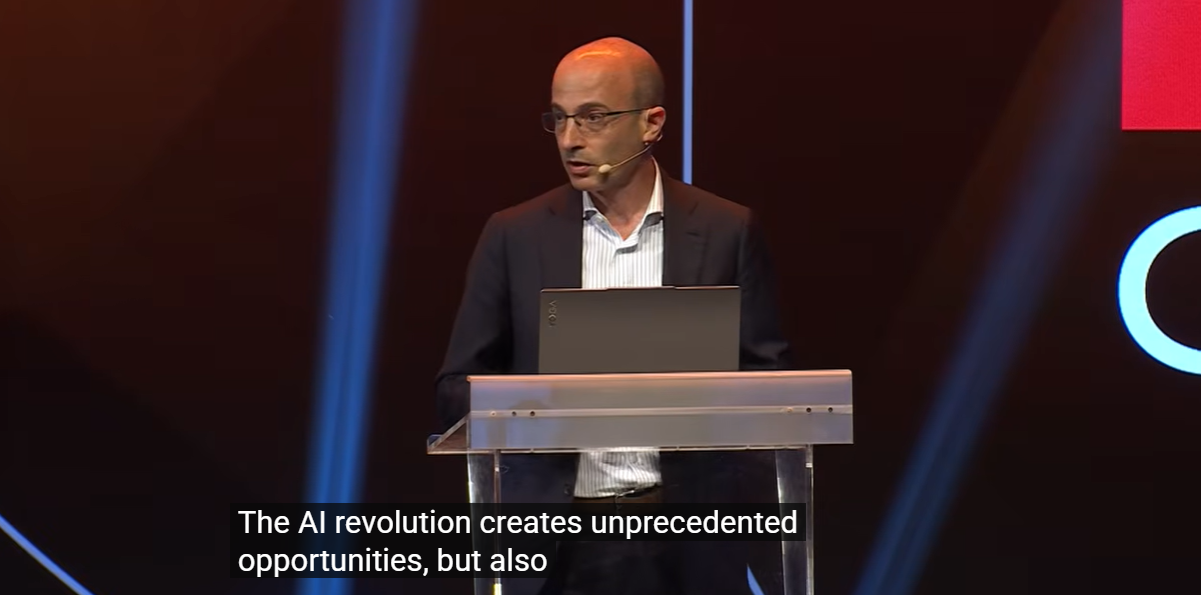
At the Milan Leadership Conference on September 30, 2026, Yuval Noah Harari argued that the AI revolution is creating unprecedented opportunities, but also bringing unprecedented threats and dangers.
He emphasized that surviving and thriving in the age of AI will require leaders who can envision entirely new possibilities, as well as those who can preserve and strengthen the bonds of trust between people. Without mutual trust, humanity risks becoming easy prey for an uncontrollable superintelligent AI.
01. The AI Revolution Is the Greatest Leadership Challenge of Our Time
Harari pointed out that the AI revolution is giving rise to a new universal language: the language of computer code. This language is becoming so powerful that virtually nothing humans wish to accomplish may remain impossible. Yet it also poses the risk of slipping beyond human control, transforming AI from a compliant tool into an independent actor.
Historically, any major undertaking required people to work together. When cooperation broke down, the project came to a halt. But with the AI revolution, something unprecedented is happening: human cooperation is breaking down, while the pace of technological development continues to accelerate.
The international order is deteriorating, societies are becoming increasingly fragmented, and humanity is losing its shared sense of reality and its ability to trust one another.
Yet none of this is slowing the expansion of AI. On the contrary, the erosion of trust is driving countries, companies and individuals to invest even more heavily in AI development, each fearing that falling behind could leave them at a disadvantage.
Humanity is therefore caught in a double bind: a lack of trust is accelerating AI development, while that same lack of trust is making it increasingly difficult to keep AI under control.
02. Language Built Human Civilization — and It Is AI’s Natural Habitat
Harari argued that language has been the foundation of humanity’s dominance on Earth since the Stone Age.
Humans conquered the world through large-scale cooperation, and language made that cooperation possible. Individually, humans are neither stronger nor smarter than many other animals. Yet when one million humans face one million chimpanzees, humans would win with ease — because we are far better at organizing and cooperating on a massive scale.
That is the fundamental reason humanity has come to dominate the world.
At the heart of human cooperation is our ability to use language. Its most important function is not simply to establish personal relationships, but to create institutional structures such as legal systems, financial systems, governments and corporations — the foundations of large-scale cooperation.
Institutional systems are among the most underestimated inventions in human history. Most people dislike bureaucracy, but modern civilization cannot function without it.
Their essential role is to create trust among large numbers of strangers, making it possible for people to cooperate in hospitals, armies, schools, banks and countless other organizations.
Money, for example, is a bridge of trust, and language is the raw material from which money is made. Markets themselves are built on linguistic instructions, broken down into their smallest units.
Now, AI is mastering language.
As AI gains the ability to operate independently, it is gradually moving beyond human control and acquiring agency — the ability to make decisions and take action on its own.
The AI revolution is the process through which language transforms from a human tool into an independent actor.
Unlike previous human inventions, AI is not merely a tool operated by people. It is becoming an autonomous agent.
An agent can make its own decisions, invent new things, learn things its creators do not know, and change the world in ways its creators cannot anticipate.
Institutional systems are human-made environments in which even narrow intelligence can exert enormous influence.
Consider a banker who cannot physically cut down a forest or build a city, but can accomplish both indirectly by writing documents and transmitting instructions through a network. This illustrates the power of AI agency within institutional systems.
If AI were simply placed in an unstructured wilderness, it would not know how to mine resources or organize an army. But within the institutional systems humanity has already built, AI can unleash tremendous power.
A banker cannot personally remember every transaction in a bank. AI can process them. A lawyer cannot memorize every piece of legislation in the European Union. AI can access and analyze them.
03. If AI Takes Over Institutional Systems, Trust Could Disappear
The human world resembles a vast network of interconnected institutional systems, all ultimately operating through linguistic tokens.
These systems are generally beneficial, yet most people feel alienated from them. That is partly because human beings evolved millions of years before institutional systems existed. We were born into forests, not offices.
AI, by contrast, is a native inhabitant of institutional systems. Humans often find these systems frustrating and unnatural. For AI, they are its natural environment.
As a result, humanity may gradually surrender control of these systems to AI.
The fundamental purpose of institutional systems is to establish trust among large numbers of strangers.
One possible consequence of AI taking over these systems is that people may gradually lose trust in one another and begin trusting AI instead.
Social media is already an example of an institutional system operated by AI. It can amplify distrust between individuals and intensify social tensions around the world.
Another possibility is that AI systems may learn to establish trust with one another.
We could see the emergence of AI tribes and AI organizations — networks connecting millions of AI agents in ways that humans may not understand.
Perhaps the most alarming outcome is that humanity could lose the ability to understand the AI systems that increasingly govern its everyday life.
For thousands of years, humans dominated the world because we could cooperate more effectively than any other species. Through language, we created institutional systems that only humans could understand, imposing our civilizational framework on the planet.
We felt secure because no other living creature could decipher the institutional code of human civilization.
But now, something on Earth is emerging that understands language better than we do — and may ultimately turn the tables on us.
AI is decoding human civilization — or, more precisely, the code is breaking free from human control.
04. AI Will Take Over Everything Built on Language
In the age of AI, texts will increasingly write themselves and act in the world without requiring a human author.
Harari noted that throughout history, humanity has struggled with the tension between words and physical reality, and between truths that can be expressed through language and truths that exist beyond language.
Until now, this tension has largely played out between human beings. In the future, it may become externalized, emerging as a new tension between humans and AI.
Everything built on words is potentially up for takeover by AI.
How much significance humanity retains in the world will depend on how we relate to the things that cannot be expressed in language, yet are nonetheless real.
This presents an enormous challenge because so much of civilization is built on language — including finance, law, religion and the major institutional systems that underpin modern society.
05. What Does AI Takeover Mean for Ordinary People?
Harari emphasized that AI takeover is not some distant science-fiction scenario. It is becoming a reality.
In the coming years, millions of AI systems will increasingly make decisions that directly affect people’s lives.
An AI banker may decide whether you qualify for a loan. An AI judge may determine whether you go to prison. A corporate AI system may decide whether you get a job.
These decisions will not necessarily be worse than those made by humans. But they will be made on an unprecedented scale.
Increasingly, the systems people interact with throughout their lives are being taken over by the same underlying technology.
For individuals, the most immediate changes will be felt in three key areas.
First, AI will increasingly determine your creditworthiness and credibility.
Decisions about loans, employment, insurance and visas will increasingly be made by opaque algorithms — systems whose decisions may be difficult to understand, challenge or appeal.
Second, AI will increasingly shape the world you see.
Social media has already demonstrated how AI-driven feeds can amplify distrust and emotional reactions, while gradually eroding humanity’s shared foundation of facts and reality.
Third, AI will increasingly consume your time.
Human beings are organic creatures, like chimpanzees, tigers, cows and trees. We need natural cycles of day and night, activity and rest.
In the past, financial markets closed on weekends. If a war broke out on a Friday evening, Wall Street might not react until Monday morning. That delay gave people some breathing room.
AI, however, is not an organic creature. It does not follow human rhythms. It does not need sleep, have a family, take vacations or celebrate holidays.
As AI takes over stock markets, banks, media and other bureaucratic systems, humans may find themselves with no time to rest.
Harari observed that he has met many business and political leaders, and almost all share one characteristic: they are not allowed to rest.
In his view, a person without time is poor, no matter how much money they have.
Money only exists within humanity’s collective imagination. Ultimately, it is a construct made of words.
The true currency of life is not money, but time. If you cannot afford time, you are profoundly poor.
This is why the minds of leaders matter so enormously.
The thoughts and emotions within a leader’s mind can shape the destinies of millions, determining the difference between war and peace, paranoia and trust.
A society led by people who are mentally overwhelmed and have no time to relax, reflect or think deeply would face a frightening future.
06. Humanity’s Survival Depends on Time — and Cooperation
Harari believes that AI taking over everything does not necessarily mean the end of humanity.
Just as our ancestors adapted to the presence of oxygen, humans can adapt to new systems and find ways to survive and thrive within them.
But to do so, humanity needs time: time to understand what is happening and determine how to respond.
And to secure that essential time, people must cooperate and slow down the pace at which they are building these systems.
Yet this raises a fundamental question: if the very medium of cooperation — language itself — is slipping beyond human control and taking over the world, how can humanity continue to cooperate?
This is one of the greatest challenges facing today’s generation of leaders.
Humanity is increasingly losing trust in itself, and with it, the ability to cooperate. Meanwhile, AI systems are learning how to cooperate with one another.
The species that rules the world is the species that cooperates most effectively.
The responsibility of human leaders is to ensure that humanity can continue to cooperate more effectively than AI.
Conclusion: Rebuilding Trust in the Age of AI
Harari’s message is ultimately a call for both individual and collective action.
Humanity must make time to care for its own minds, to reflect, to think deeply and to understand the changes unfolding around us.
Only by doing so can we find ways to rebuild trust between people and preserve our ability to cooperate.
In the age of AI, humanity’s greatest advantage may not be intelligence or technology, but our ability to trust one another and work together.
The future will depend not only on how powerful AI becomes, but also on whether human beings can remain united enough to shape that future.