

Silicon Valley is falling in love with silicon all over again.
According to Physical AI and the Future of Robotics, a report published by First Citizens Bank (formerly Silicon Valley Bank), with warehouse automation data contributed by GLP, U.S. venture capital investment in Physical AI is projected to reach $29 billion in 2026, a record high and approximately double the 2025 level.
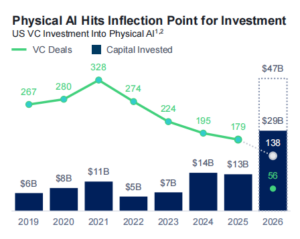
However, the number of deals has declined from 328 in 2021 to just 138, while average deal sizes continue to grow. Mega-rounds exceeding $500 million account for 84% of investment in supply chain AI and hardware, with capital increasingly concentrated in leading companies such as Waymo, Figure, Skild AI, and Physical Intelligence.
This trend points to two major developments.
First, the AI industry is entering a capital-intensive phase.
The companies attracting the largest funding rounds are primarily those developing complete robotic systems and platforms. The share of seed-stage deals has fallen from 57% in 2024 to 39%, suggesting that nearly half of early-stage companies are struggling to progress beyond Series A or earlier funding stages.
Second, robotics foundation models remain an underfunded segment.
Since 2023, robotics foundation models have accounted for just 11% of Physical AI investment and only 1% of total AI investment.
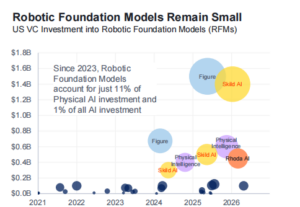
This reveals a significant imbalance in the market. Capital is flowing overwhelmingly toward complete robotic systems and applications, while the foundational technology layer is receiving relatively little attention. Yet this is precisely the layer that will determine whether robots can achieve true generalization across different tasks and environments.
The report also highlights growing enterprise demand for automation. Mentions of “automation” during earnings calls by publicly listed companies have tripled compared with 2020.
The addressable market for robotics is expanding beyond fixed positions on automotive assembly lines to encompass virtually every warehouse, factory, and logistics hub. This is one of the main reasons investment is flowing toward companies developing complete robotic systems and platforms.
But large-scale deployment of Physical AI faces a fundamental challenge: physical constraints.
The first major constraint is computing power. As the addressable market expands, robots must operate in increasingly complex environments, placing greater demands on onboard computing capabilities.
Computing Power, HBM, and Electricity: Three Major Cost Constraints
Latency is the first critical constraint. Physical AI cannot rely entirely on cloud computing.
Autonomous driving and warehouse picking require millisecond-level decision-making. The round-trip latency involved in cloud-based processing is simply unacceptable for many real-world physical applications. Computing power must therefore be available directly on the robot, supported by high-bandwidth memory (HBM) and other advanced memory chips — resources that are already in high demand from data centers.
Currently, 90% of global HBM production capacity is committed to four major chip manufacturers. As robots become more intelligent and capable of handling a wider range of tasks, their memory requirements will continue to increase.
This means the cost floor for robotics is ultimately shaped by the same supply chain that supports the global data center industry.
The report also points to a recent stress test for this supply chain. The closure of the Strait of Hormuz by Iran drove the Global Supply Chain Pressure Index to a four-year high. Rising energy prices pushed up semiconductor manufacturing costs, while printed circuit board (PCB) prices have increased by 17% since December 2025 — exceeding the 12% increase in broader commodity prices.
Electricity is emerging as another increasingly important constraint on Physical AI.
Data centers are among the largest sources of electricity demand. More than 830 data centers are currently under construction in the United States, while vacancy rates in major data center markets have fallen below 1%. The median waiting time for grid interconnection approvals has reached 45 months.
Electricity is increasingly replacing chips as a key bottleneck to AI development.
Robots and edge devices are also adding to electricity demand. The report projects that investment in edge computing will reach $3.4 billion in 2026. Companies such as Hailo and Rebellions are among the key players focused on reducing the cost of edge inference.
Meanwhile, venture capital investment in data centers has exceeded $12 billion.
Although edge devices currently consume relatively little electricity compared with data centers, demand will grow as robotic deployment expands. As more intelligence moves from centralized infrastructure to the physical edge, electricity requirements will rise accordingly.
In the Physical AI era, power availability will become an increasingly important factor.
Warehouses: The Ultimate Testing Ground for Physical AI
Warehouses are emerging as one of the most demanding real-world testing environments for Physical AI.
GLP, one of the world’s largest logistics real estate providers, with approximately 1.3 billion square feet under management, surveyed around 400 warehouse operators and decision-makers.
The findings reveal growing confidence in automation. Over the past year, 67% of logistics executives have become more optimistic about automation, while only 10% expressed skepticism.
However, actual deployment tells a different story. Only a small group of mature operators have achieved large-scale implementation, while most companies remain in the pilot phase.
The adoption landscape can be divided into four categories:
- Established: Conveyor and sorting systems, with approximately 90% adoption among large enterprises.
- Approaching scale: Goods-to-person systems, at approximately 75% adoption, and autonomous mobile robots (AMRs), at around 65%.
- Still in pilot stages: Robotic picking and palletizing, with nearly 65% of deployments still in the pilot phase.
- Under evaluation: Computer vision and AI-powered scanning, with 75% of respondents still evaluating these technologies.
Overall, 83% of respondents reported that their warehouses had not yet automated a single operational process, highlighting the enormous untapped potential of the market.
For companies that have already adopted automation, machine reliability and uptime have exceeded expectations. The real challenge is that automated systems often struggle to keep pace with the operational realities of warehouses.
For example, during major promotional campaigns, order volumes can double, overwhelming systems that were designed around standardized workflows.
Replacing an existing system can also be costly and disruptive, requiring facility modifications, process redesign, and lengthy commissioning periods.
The problem is that warehouse operations are inherently unpredictable. Product mix changes, workforce turnover, and seasonal demand peaks can all create exceptions that rigid automated systems are not designed to handle. When these situations arise, human workers still have to step in.
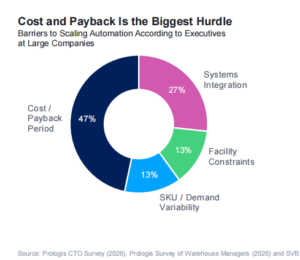
In other words, the biggest barriers to expanding warehouse automation are implementation costs and payback periods (47%), followed by system integration challenges (27%).
This also helps explain why 75% of warehouse technology leaders consider humanoid robots to be the most overhyped technology in the sector.
ROI Will Determine the Winners
Traditional automation has a clearly defined operating environment: new warehouses, high throughput, standardized processes, and the ability to support fixed infrastructure investments.
But much of the existing warehouse stock is older, space-constrained, and characterized by diverse product categories. Rigid automation systems are often difficult to retrofit into these facilities.
This creates an opportunity for flexible robots capable of operating in environments originally designed for humans — without requiring major facility modifications or fundamental changes to existing workflows.
Humanoid robots have attracted the most attention, but bipedal systems are complex, expensive, and still lack sufficient commercial validation.
The eventual winners may be humanoid robots, wheeled robots, or entirely different configurations. What matters most is whether they can operate reliably in real warehouse environments while delivering a compelling return on investment.
According to the report, the total cost of deploying a humanoid robot is currently in the region of $500,000. This estimate includes maintenance, software, electricity, computing, and first-year integration costs, with integration assumed to cost three times the price of the robot itself.
Over a seven-year period, the cumulative cost of deploying a humanoid robot remains higher than that of human labor.
The real inflection point will come when economies of scale drive total deployment costs below the cost of human labor. In certain applications, this could reduce the payback period to less than one year.
Capital markets are already positioning themselves for this potential turning point.
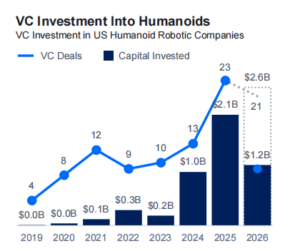
U.S. venture capital investment in humanoid robotics declined from $2.1 billion across 23 deals in 2025 to a projected $1.2 billion across 21 deals in 2026. The shift suggests that investors are increasingly waiting for evidence of mass-production economics rather than funding ambitious narratives alone.
Meanwhile, Amazon has invested in or acquired 10 VC-backed hardware companies over the past 12 months alone, bringing its cumulative total to at least 32 over five years. Its investments span a broad range of robotic applications, from companion robots to industrial humanoids.
At the level of the “brain,” however, robotics foundation models remain at an early stage.
The development trajectory of robotics AI is fundamentally different from that of large language models.
The rapid scaling of LLMs was made possible largely by the enormous volume of readily available text data on the internet.
Robotics faces a much more complex data challenge. It requires diverse, high-quality datasets involving sensors, physical interactions, safety requirements, and simulation environments.
Without breakthroughs at this foundational layer, robots will struggle to generalize their capabilities across different tasks and real-world environments.
The ChatGPT moment for Physical AI has yet to arrive, but the race to build its underlying infrastructure is already underway.
Conclusion: The Real Competition Is About Deployment Economics
The competition in Physical AI is about far more than algorithms and hardware. It is increasingly a contest over supply chain resilience, infrastructure availability, and unit economics.
For now, capital is concentrated in complete robotic systems and platforms, while investment in robotics foundation models remains relatively limited. This imbalance is not unusual in an early-stage market.
But as robots move from laboratories into factories and warehouses, technological breakthroughs alone will not determine the winners.
The decisive factor will be whether robots can deliver reliable performance in real-world operations — and whether the economics make commercial sense.
Ultimately, the warehouse will be where Physical AI proves its value.