

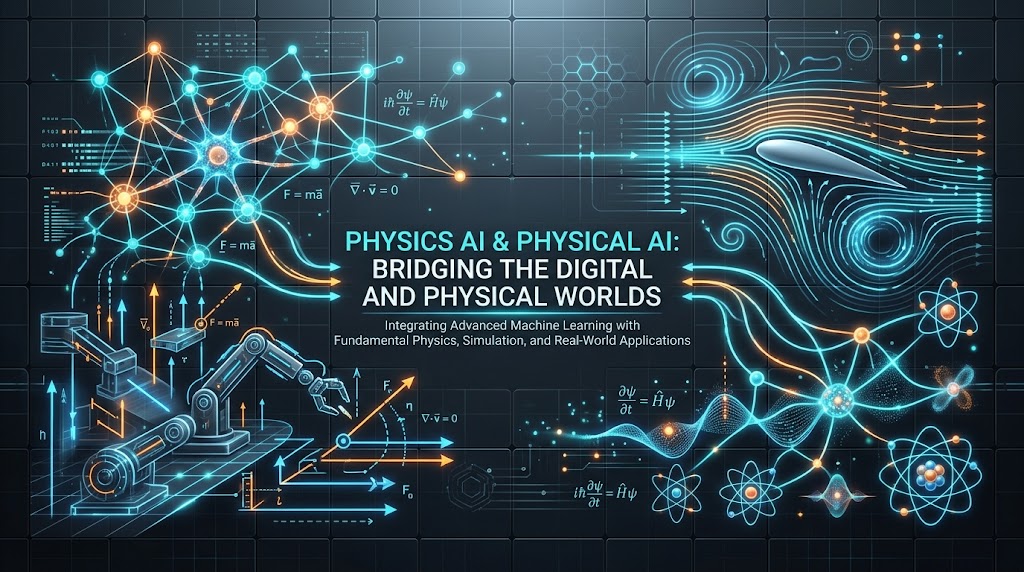
For years, generative AI and large language models (LLMs) have demonstrated extraordinary capabilities in processing text, code, and visual media. However, as artificial intelligence transitions from the digital realm to physical environments, pure data-driven approaches are running into fundamental real-world limitations.
Physics-Informed AI (Physics-AI)—and the broader wave of Physical AI—marks a pivotal milestone: the shift from purely statistical pattern recognition to a deep computational understanding of physical reality.
The Bottleneck of Purely Data-Driven Intelligence
Traditional deep learning relies heavily on vast quantities of data. While effective in digital domains, this statistical paradigm struggles when confronted with complex physical systems:
Physical Inconsistencies (“Hallucinations”): Conventional models trained solely on observational data frequently output predictions that violate basic physical laws, such as conservation of mass or energy.
Prohibitive Data Collection Costs: Gathering high-fidelity empirical data from specialized wind tunnels, nuclear reactors, or deep-space sensors is exceptionally expensive and time-consuming.
The Black-Box Safety Barrier: High-stakes engineering sectors—like aerospace and autonomous transportation—demand verifiable reliability, which black-box deep learning models cannot guarantee.
Dual Core Paradigms of Physics-AI
1. Physics-Informed Neural Networks (PINNs)
Rather than treating physical principles as external validation metrics, PINNs embed differential equations (e.g., Navier-Stokes, Maxwell, or Schrödinger equations) directly into the loss functions during model training:

By penalizing any prediction that deviates from fundamental conservation laws, these models achieve remarkable extrapolation accuracy even with extremely sparse training datasets.
2. Physical Embodiment & Real-World Simulation
In robotics and autonomous systems, Physical AI integrates GPU-accelerated physics engines with deep reinforcement learning. This allows embodied agents to develop an intuitive “sense of physics”—learning how friction, elasticity, and momentum behave before stepping foot into the physical world.
High-Impact Industrial Applications
Thermonuclear Fusion Control: Real-time prediction and mitigation of plasma instabilities, enabling stable tokamak confinement for clean energy generation.
Accelerated Physics Simulations: Replacing computationally expensive Finite Element Analysis (FEA) and Computational Fluid Dynamics (CFD) with AI surrogate models that run 1000x faster with near-zero accuracy loss.
Embodied Intelligence & Robotics: Empowering quadrupedal robots and autonomous drones to dynamically evaluate terrain resistance, load dynamics, and obstacle avoidance in real time.
Looking Ahead
If large language models gave AI the ability to speak and reason, Physics-AI provides the framework for AI to interact with and transform the material world. As we move toward AI-driven scientific discovery (AI4Science), this paradigm will remain at the core of next-generation engineering, robotics, and climate modeling.