

On September 3, 2026, humanoid robotics leader Figure and AI cloud infrastructure provider Nscale announced a major strategic partnership. Far more than a conventional commercial agreement, the deal signals a significant shift in the competitive landscape for embodied and physical AI, as leading players move to secure the computing infrastructure required to scale their systems over the next several years.
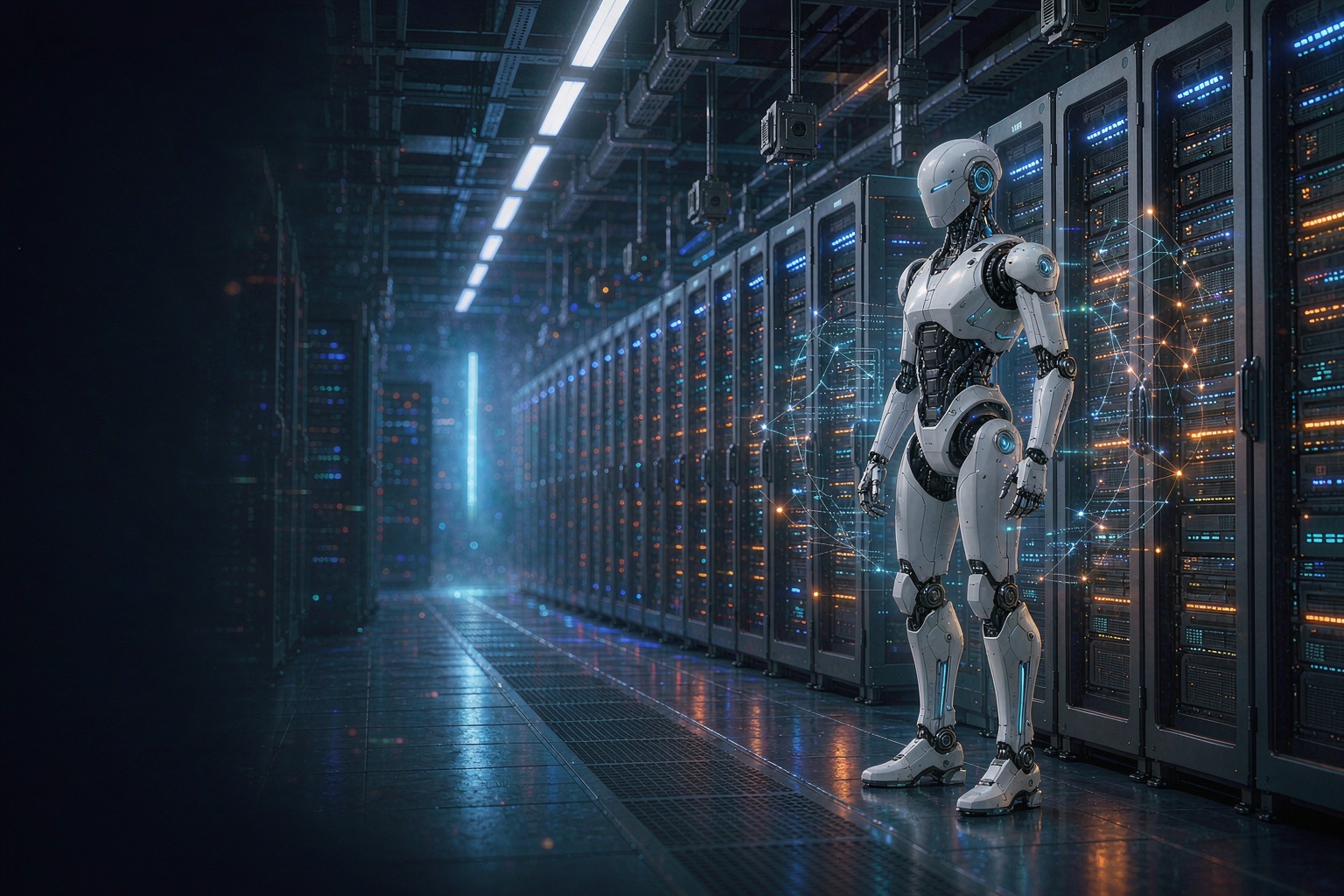
Under the agreement, Nscale will become Figure’s exclusive preferred computing provider. Beginning in the second half of 2027, the companies plan to deploy a hyperscale computing cluster comprising 100,000 NVIDIA Vera Rubin GPUs in phases at Nscale’s Bastrop data center in Texas.
The initial commitment is valued at approximately $3.5 billion, with the potential to expand to more than $6 billion over time, making the project one of the largest announced AI infrastructure commitments associated with the humanoid robotics sector.
Unlike conventional on-demand cloud capacity arrangements, the deployment is scheduled to begin nearly a year from now. The strategic rationale is therefore not simply to address an immediate shortage of compute, but to secure long-term access to advanced GPU capacity at unprecedented scale.
As demand for NVIDIA’s next-generation architectures continues to outpace supply, Figure’s decision to commit to a large, multi-year infrastructure deployment could give the company greater certainty over the compute resources required to scale its general-purpose humanoid robots.
Index + Hyperscale Compute: Building a Data-Driven Advantage for Figure
A common misconception is that the rise of large language models has already consumed the majority of available AI compute resources. In reality, the computational requirements of physical AI and humanoid robotics are fundamentally different from those of conventional language models.
Humanoid robots must operate continuously in dynamic physical environments. Their models need to process and coordinate vision, tactile sensing, spatial awareness, motion planning, and motor control in real time.
Real-world environments also introduce variables that are difficult to reproduce in purely simulated settings: changing lighting, unexpected obstacles, contact dynamics, imperfect movements, and constantly shifting environmental conditions. These factors create substantial demands on computational throughput, latency, reliability, and parallel processing.
Figure’s self-developed Helix robotic intelligence platform is designed around this multimodal, real-time interaction paradigm.
To address the persistent gap between simulation and real-world deployment, Figure has also introduced its Index data program, which is designed to dramatically accelerate the generation of real-world training data.
According to Figure, Index can generate the equivalent of 35 minutes of high-quality real-world interaction data every second, enabling the rapid construction of large-scale datasets based on actual human-robot and robot-environment interactions.
For physical AI, data is the fuel—but compute is the engine.
If compute capacity cannot keep pace with the growth of training data, additional data alone will not necessarily translate into better robotic capabilities. Training throughput becomes a bottleneck, limiting improvements in manipulation accuracy, environmental adaptability, and autonomous task execution.
Nscale’s planned hyperscale infrastructure could therefore provide Helix with the compute capacity needed for sustained model development, allowing Figure to continuously turn real-world interaction data into improvements in physical intelligence.
The resulting cycle is straightforward:
Real-world data → model training → improved capabilities → more capable robots → more real-world data.
At sufficient scale, this feedback loop could become one of the key drivers of progress in physical AI.
A Potential Physical AI Business Loop: From Powering Robots to Robots Powering Infrastructure
The strategic significance of the partnership extends beyond a traditional cloud infrastructure agreement.
Nscale is not only positioned as Figure’s computing provider; the companies are also establishing a deeper strategic relationship that includes investment and potential operational collaboration.
One of the most notable elements of the agreement is the companies’ plan to explore the use of Figure humanoid robots in the operation and maintenance of Nscale’s data centers.
In the future, humanoid robots trained using the massive computing infrastructure they themselves help support could potentially perform physical tasks inside data centers, including:
- Facility and equipment inspections
- Server and hardware maintenance
- Cable management
- Equipment handling and movement
- Routine physical operations in controlled industrial environments
If successfully deployed, this would create a compelling feedback loop for physical AI:
Compute infrastructure trains physical intelligence, while physical intelligence helps operate compute infrastructure.
The significance goes beyond the symbolism of AI “entering the physical world.” Data centers offer highly structured industrial environments in which robots can be evaluated against concrete requirements for reliability, precision, safety, and operational consistency.
For Figure, this creates two potential strategic benefits.
1. Long-term access to compute infrastructure
Securing dedicated access to large-scale, next-generation GPU capacity could give Figure greater visibility into its long-term training and inference requirements as it scales its humanoid robotics platform.
That infrastructure advantage could also support continued investment in model development, robotics talent, data collection, and deployment.
2. A high-value real-world deployment environment
Data centers could serve as a controlled but commercially relevant testing ground for humanoid robots.
Rather than evaluating robots only in demonstrations or laboratory environments, Figure could test their ability to perform repeatable industrial tasks under real operational constraints. Such deployments could generate additional data while simultaneously helping validate the reliability and practical utility of the robots.
More Than a GPU Deal
Taken together, the Figure-Nscale partnership represents more than a large-scale GPU procurement agreement.
It illustrates a broader direction for the physical AI industry: the convergence of compute infrastructure, large-scale real-world data, foundation models, and industrial deployment.
Figure’s strategy combines three critical components:
Large-scale compute to train increasingly capable models;
Real-world data to improve performance outside simulated environments;
Industrial deployment to validate and continuously improve robotic capabilities.
The planned 100,000-GPU infrastructure could provide the computing foundation for Helix to process the growing volume of real-world data generated through Figure’s Index program. In turn, improvements in the model could enable robots to perceive their environments more effectively, manipulate objects with greater precision, and perform increasingly complex autonomous tasks.
The broader competitive landscape of AI may therefore be expanding beyond language and digital interfaces toward physical productivity.
As AI systems move from generating information to performing work in the physical world, access to compute, data, models, and real-world deployment environments will increasingly become interconnected.
The Figure-Nscale partnership offers an early example of what that infrastructure ecosystem could look like: compute trains the robots, robots generate new data, and robots may eventually help operate the infrastructure that trains them.
That convergence could become an important architectural pattern for the next phase of physical AI.