

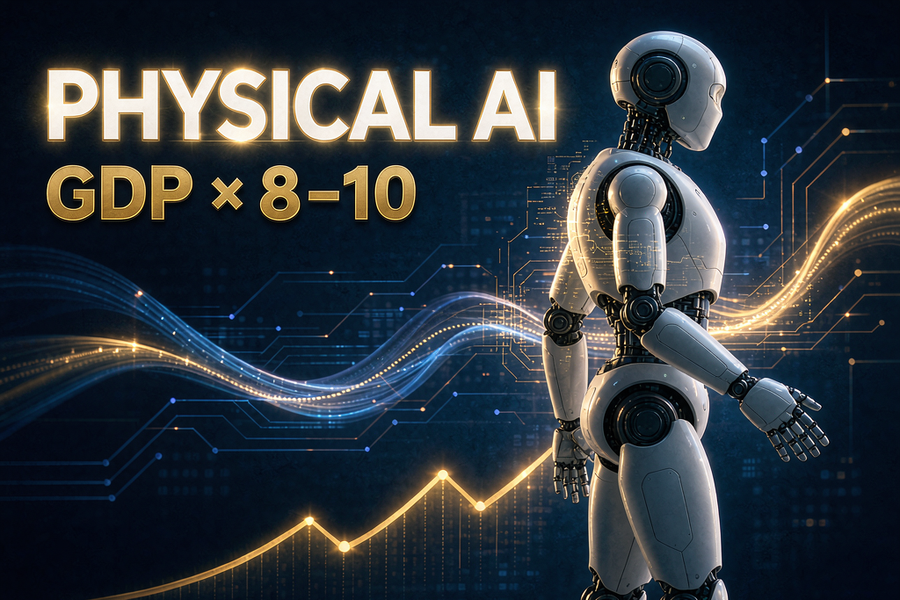
Introduction: Morgan Stanley predicts that physical AI could drive global GDP to 8–10 times its current level over the coming decades, potentially reshaping the global manufacturing landscape.
Over the past several decades, the center of gravity of global manufacturing has steadily shifted toward China. From consumer electronics and automotive components to rare earth materials and highly integrated supply chains, China has established itself as the world’s manufacturing hub, while much of the United States’ manufacturing base has moved overseas.
Recently, Adam Jonas, an analyst at Morgan Stanley, said in an interview with Bloomberg TV that the rapid advancement of physical AI could present a major opportunity for the United States to revitalize its manufacturing sector and regain a competitive edge in industrial production.
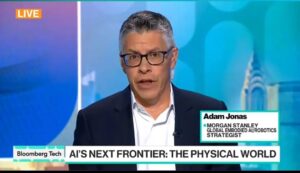
Jonas suggested that the combination of physical AI and robotics could multiply global GDP over the next decade or two. He also sees this technological shift as a potential turning point for the United States, creating an opportunity to bring manufacturing back home and rebuild industrial resilience.
At the same time, China is expected to retain its leadership in manufacturing and supply chains, particularly in critical minerals and rare earth materials—areas where its position is unlikely to be easily displaced in the near term.
Jonas also emphasized that countries seeking to advance robotics, data centers and electronics manufacturing will need to maintain working relationships with China. The United States is no exception.
Bringing physical AI into the real world will require participation across a wide range of industries. For the United States, this presents a strategic dilemma: reshoring manufacturing and strengthening domestic employment will require reducing dependence on China, yet the country’s manufacturing ecosystem and supply chains remain difficult to replace in the short term. Closer cooperation with China may therefore remain necessary even as the United States seeks to rebuild its industrial base.
Regulation, National Security and the Future of Physical AI
When asked whether physical AI would face regulatory oversight, Jonas gave a clear answer: regulation will inevitably play a role in the development of physical AI, although its timing and form may vary. In his view, regulation is unlikely to alter the broader direction of technological progress.
Advanced technologies often have potential military applications, and robots powered by AI are no exception. Their dual-use capabilities are becoming an increasingly important strategic consideration. The deployment of unmanned systems on battlefields in Ukraine and around the Strait of Hormuz illustrates why governments are paying closer attention to the military implications of autonomous technologies.
Why Tesla and SpaceX Could Play a Leading Role
Morgan Stanley closely tracks Elon Musk’s Tesla and SpaceX in its research on embodied intelligence and robotics. Jonas expressed strong confidence in the potential of the two companies’ complementary capabilities.
Tesla brings manufacturing expertise, data collection and the ability to extend AI into the physical world through robots and autonomous systems. SpaceX contributes connectivity and AI-related capabilities, alongside substantial manufacturing expertise of its own.
Both companies possess significant capabilities in physical AI. Together, their strengths could enable what Jonas describes as “intelligence at scale”—the ability to deploy intelligent systems across a vast number of machines and real-world applications.
Morgan Stanley forecasts that hundreds of billions of robots could be operating in everyday life over the next 10 to 20 years. These machines would take many forms, including aerial robots, ground-based robots, autonomous vehicles, mobile robots and industrial robots.
Connected through networks, these machines could collectively form a kind of swarm intelligence, potentially carrying out the vast majority of the world’s inference workloads.
Importantly, not all of these robots will depend on centralized data centers to perform their tasks.
Edge AI: Why Robots Need to Think Locally
Jonas believes that inference capabilities will increasingly move closer to where data is generated and decisions need to be made.
Running every inference task through a data center or a high-performance GPU, he suggested, is like driving a Ferrari to pick up a carton of milk: it is often an unnecessarily expensive way to get the job done.
For robots, the ability to process information and make decisions locally will be critical to achieving true autonomy. Edge inference can reduce dependence on centralized computing infrastructure and enable robots to respond more directly to their physical surroundings.
As physical AI advances, the combination of on-device intelligence, efficient computing and real-time decision-making could become a key factor in scaling robotic systems across industries.
Humanoid Robots: More Than a Product, but Not the Only Form Factor
Humanoid robots are undoubtedly among the most closely watched categories in robotics today. However, Jonas offered a more nuanced perspective on their current role.
In his assessment, humanoid robots currently function in part as “recruiting tools” and “fundraising tools”—high-profile technologies that help companies attract talent, secure investment and build momentum around their broader AI ambitions.
Morgan Stanley expects humanoid robots to remain an important category by 2050, but they will be just one among thousands of different robotic form factors.
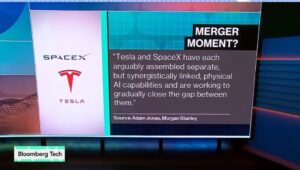
Scaling thousands of different types of robots will require formidable manufacturing capabilities, robust connectivity and the ability to deploy intelligence across diverse real-world environments. Jonas believes Tesla and SpaceX are particularly well positioned in these areas.
He sees the two companies as potential driving forces behind America’s industrial revival and its efforts to keep pace with—or even surpass—geopolitical competitors in physical AI.
Tesla Optimus and the Next Phase of Industrial Reshoring
Tesla’s Optimus humanoid robot has emerged as one of the most closely watched products in this broader industrial transformation.
Although Jonas cautioned that humanoid robots currently serve, in part, as tools for attracting talent and investment, he still views them as an important category within the future robotics ecosystem.
Ultimately, however, the revival of American manufacturing will depend on more than any single robot or product. It will require the large-scale deployment of intelligent machines, advances in manufacturing infrastructure, reliable supply chains and the integration of AI into real-world industrial operations.
Physical AI could help reshape where and how goods are produced, potentially making domestic manufacturing more competitive while strengthening industrial resilience.
Yet China’s established manufacturing ecosystem, expertise in critical materials and extensive supply-chain networks will remain important factors in determining how quickly—and where—this transformation takes place.
The broader takeaway is that the future of physical AI may not be defined by a competition between software and hardware, or even between humanoid robots and other machines. It may instead be shaped by the countries and companies capable of combining intelligence, connectivity and manufacturing at scale.