

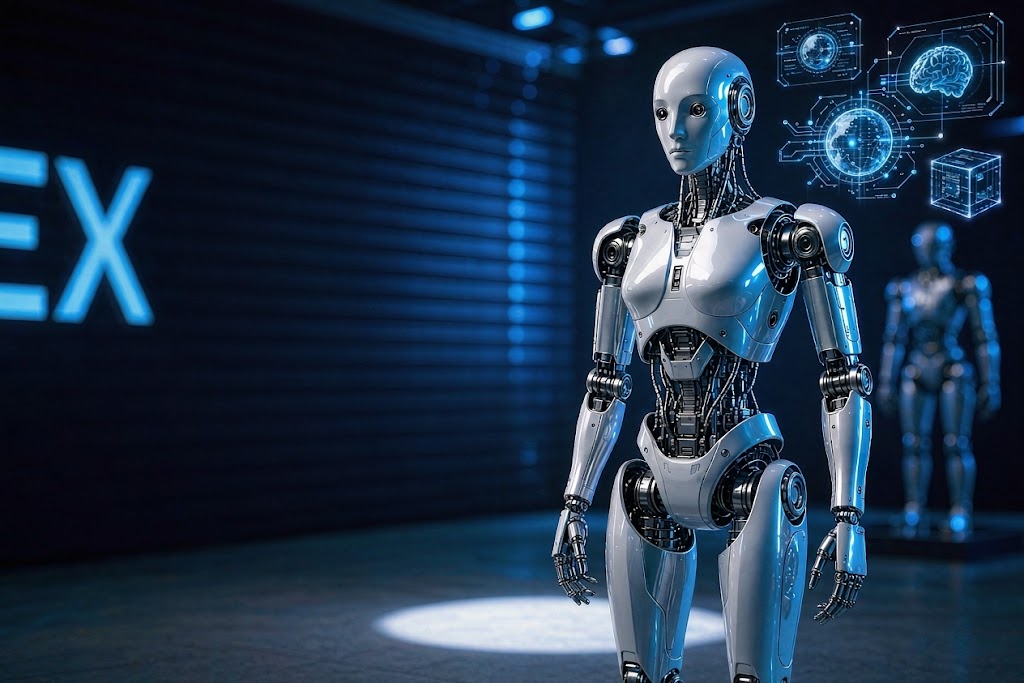
In the first half of 2026, the world shipped nearly 25,000 humanoid robots, up 432% year over year. Impressive numbers — but what interests me most isn’t the numbers themselves. It’s the shift in narrative they signal: Physical AI is graduating from its adolescence of “technical demos” into the adulthood of “scaled delivery.” And the exam hall for that coming-of-age isn’t the lab. It’s the real world — including the trade show floor.
1. For the First Time, the Data Speaks Louder Than the Videos
Conversations about embodied AI used to run on videos and imagination. In the first half of this year, the industry finally had multi-source data that cross-validates. IDC counts global shipments near 25,000 units and a $740M market; Frost & Sullivan’s count puts H1 sales at 36,000 units — more than all of 2025 combined. China accounts for roughly 77.9% of shipments, and the top five vendors by revenue are all Chinese companies.
Meanwhile, the price curve is steepening downward: Unitree’s R1 dropped to about $4,100, Songyan Dynamics pushed a bipedal humanoid under ¥10,000 (~$1,400), and Goldman Sachs projects average unit prices will nearly halve over the next decade — down 49%. The supply-side evidence chain is complete: mass-production capability is proven, and the price inflection has arrived.

2. The Real Bottleneck Has Moved
But reading “shipment explosion” as “industry maturity” is the most dangerous misread of the year. The industry consensus is quietly shifting: the binding constraint is no longer building the hardware — it’s scene adaptation and embodied software capability.
Industry insiders put it bluntly: building one prototype is easy; guaranteeing batch consistency across tens of thousands of units is the real challenge — a complex engineering problem spanning supply chains, manufacturing standards and quality systems, where not a single link can be weak. That’s why UBTech now builds humanoids on automotive-grade takt times (one unit every 10 minutes), and QiYuan Robotics has adopted the IATF16949 automotive quality standard (one every 2.5 minutes).
The industrialization of Physical AI isn’t a single-point breakthrough — it’s a complex engineering effort where not a single link can be weak. In the prototype era we competed on who was more dazzling; in the delivery era we compete on who is more consistent.
3. Videos Can’t Be Trusted. Live Floors Can. The Trade Show Is Being Revalued.
As a trade show organizer, this is the point I most want to make. What separates Physical AI from every other branch of AI is this: it must submit to immediate, physical judgment. A language model can retry a wrong answer; a humanoid robot that falls in front of three hundred onlookers has simply fallen.
This year’s IFA in Berlin sent the signal: more than 100 Chinese embodied-AI companies exhibited — and instead of striking poses and playing showreels, they built real, lifelike scenes on the floor. Robots walked alongside children, ground coffee, folded laundry — while European buyers grilled them on battery life, collision avoidance and fall prevention. German media called it a reset of global expectations for how fast frontier tech can land.
My forecast: trade shows are undergoing a revaluation — from “showcase” to “proving ground.” Tens of thousands of unpredictable visitors a day, real flooring, real interruptions, real chaos — that’s long-tail data and validation no laboratory can manufacture. For organizers, what we sell is no longer just exposure. It’s something far scarcer: credibility. A company willing to run its robot unassisted on an open floor all day deserves more trust than one willing only to post an edited video.
4. The Sobering Part: From “Affordable” to “Worth Buying,” Six Hurdles Remain
Amid the boom narrative, keep one dose of sobriety. Average gross margins for robot OEMs currently sit at just 8%–12% (15%–25% for the body alone) — the shipment sprint hasn’t yet become a healthy business model. For household users, the road from “affordable” to “worth buying” still crosses six hurdles: safety, usability, reliability, privacy, after-sales and the software ecosystem. Commercialization has moved from “capability showcase” to “operational validation”: a robot that can make one cup of coffee proves nothing — one that consistently fulfills orders and produces measurable business output does.
5. Conclusion: Three Judgments
- The narrative inflection has arrived. The industry has moved from “who demos better” to “who delivers consistently.” H1 2026 is the dividing line.
- The scarcest resource of the next phase is real-world scenes. Data, validation and trust all grow in real environments — and the trade show floor is the largest, most frequent aggregator of them. That is a historic opportunity for organizers.
- For participants, one test matters: whether you dare to run in the open, for hours, unscripted. On the 2027 show floor, the hardest-hitting panel won’t be a spec sheet — it will be the failure rate and continuous uptime.
The second half of Physical AI won’t be won on imagination. It will be won on credibility — and credibility can only be earned in the real world.