

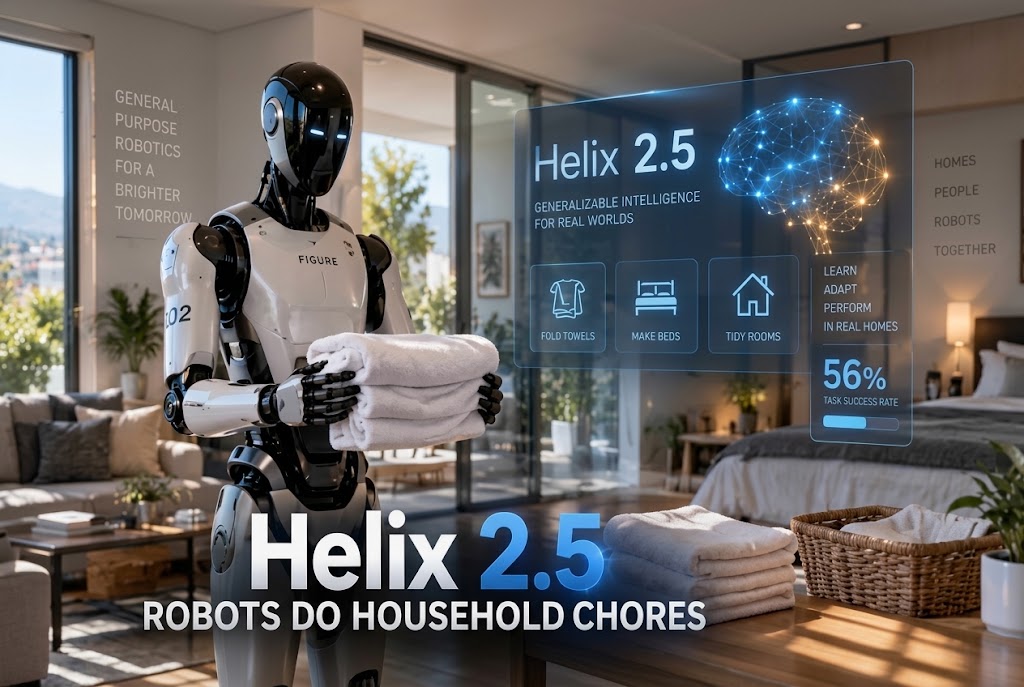
There is a new breakout player in the humanoid robotics industry.
Founded just three years ago, the company has reportedly reached a valuation of more than $36 billion, making it the world’s most highly valued humanoid robotics company.
The company is based in the United States and is called Figure AI.
And behind the company’s rapid rise is its founder and CEO, Brett Adcock.

Born in 1986 and raised on a family farm in rural Illinois, Adcock chose a very different path from the family business.
At just 16, he had already entered the internet business, running e-commerce and content websites.
Later, while studying at the University of Florida, he initially majored in industrial engineering. But he soon realized that engineering was not where his interests lay. He switched to business administration, focusing on finance and real estate.
After graduation, he worked at Bank of America and later at a hedge fund.
Those experiences taught him to evaluate businesses from two perspectives: capital and markets.
From a Failed-to-Fund Startup to a $100 Million Exit
In 2012, at the age of 26, Adcock founded Vettery, a marketplace focused on specialized recruiting.
For the first three years, not a single venture capital firm was willing to invest in the company.
At one point, Adcock was so short on cash that he had to borrow money to pay his rent.

Things eventually changed.
In 2017, Vettery raised $12 million in funding. A year later, the company was acquired by Swiss staffing giant Adecco Group for $100 million.
The deal brought Adcock considerable attention in Silicon Valley.
But he was far from finished.
His Next Bet: Electric Aircraft
Adcock went on to co-found Archer Aviation, a company focused on electric vertical takeoff and landing aircraft, or eVTOLs.
There was just one problem: he knew almost nothing about how aircraft actually worked.
Instead of treating that as a barrier, Adcock approached it like a founder.
He created a spreadsheet and spent six months calling around 300 aviation experts, asking questions and learning everything he could.
He even returned to the University of Florida to take courses in mechanical and aerospace engineering.
In 2021, Archer Aviation went public through a SPAC transaction, reaching a market valuation of approximately $2.7 billion at one point.
By 2022, at just 36 years old, Adcock had already established himself as a prominent Silicon Valley entrepreneur.
But that same year, he stepped down from Archer’s board and decided to start over once again.
This time, he turned his attention to humanoid robots.
The Big Bet on Humanoid Robots
In 2022, Adcock founded Figure AI from the ground up.
His thesis was straightforward:
Humanoid robots could become one of the defining technologies of the next 30 years — and potentially the ultimate physical form of AGI.
From the very beginning, Adcock moved quickly to assemble a world-class team.
Figure recruited experienced engineers and researchers from companies and organizations including Boston Dynamics, Tesla, Google DeepMind, and Apple’s autonomous driving programs.
Collectively, the core team brought more than 100 years of robotics experience to the company.
But once again, fundraising proved to be a major challenge.
Adcock has said that during Figure’s first year, he gave multiple fundraising pitches, yet not a single venture capitalist was willing to invest.
Instead of slowing down, the company continued focusing on product development.
The Prototype That Changed Everything
In March 2023, roughly one year after the company was founded, Figure announced that its first humanoid prototype, Figure 01, had been completed.
The company said it planned to begin walking tests within the following 30 days.
That milestone immediately attracted attention from investors and the broader technology industry.
Two months later, in May 2023, Figure raised $70 million in Series A funding, led by Parkway Venture Capital.
But having a working prototype was only the beginning.
Turning a prototype into a commercially viable robot required enormous amounts of capital and continued R&D. Within months, Figure was once again facing intense cash-flow pressure.
Then came the breakthrough.
When Figure 01 Met OpenAI
Figure connected its humanoid robot to OpenAI’s large language models.
In a widely shared demonstration, the robot was able to interact with a person, understand verbal instructions, and perform tasks such as organizing objects on a table.
The demonstration went viral.
For major technology companies, it offered something more significant than a viral video: a potential path for large AI models to move beyond the digital world and into the physical world.
That attracted the attention of companies including NVIDIA, Microsoft, and OpenAI.
Before Figure had even been in business for two years, the company secured $675 million in Series B funding, with participation from major technology and investment players including NVIDIA and Microsoft.
The company’s valuation surged.
Then came another major funding round.
A Valuation Surge
In 2025, Figure raised more than $1 billion in Series C funding.
Within less than a year and a half, its reported valuation had climbed to more than $39 billion.
For a company that had been founded only a few years earlier, the speed of that rise was extraordinary.
But Adcock was not satisfied with simply integrating existing AI technology into robots.
Why Figure Walked Away from OpenAI
In February 2025, Figure announced that it was ending its partnership with OpenAI.
Adcock’s reasoning was that if humanoid robots were going to solve real-world embodied intelligence problems at scale, Figure needed to control the entire robotics AI stack itself.
The company subsequently began developing its own AI models.
That effort led to Helix, Figure’s proprietary AI system for humanoid robots.
From Factory Floors to Real Homes
The next step was even more ambitious.
In September 2026, Figure deployed robots powered by its Helix 2.5 model into 30 previously unfamiliar homes across the San Francisco Bay Area, where they were tasked with carrying out everyday household chores.

The system incorporates an Index pre-training model, which allows robots to learn from large volumes of videos showing humans performing everyday tasks.
The idea is simple but powerful: rather than learning every task exclusively through explicit programming or controlled demonstrations, the robot first develops a broader understanding of how humans interact with the physical world.
According to Figure, this approach helped push task completion rates to 56%, compared with just 9% for robots performing similar tasks in unfamiliar environments previously.
The significance goes beyond the numbers.
Humanoid robots are moving from simply executing pre-defined commands toward being able to observe their surroundings, understand what needs to be done, and act more autonomously.
That is one of the key capabilities separating the next generation of humanoid robots from traditional industrial automation.
The Next Battle: Open-Ended Real-World Intelligence
Figure AI’s trajectory highlights a broader shift taking place across the humanoid robotics industry.
The early phase of the race was largely about building a robot that could walk, balance, manipulate objects, and perform impressive demonstrations.
The next phase is likely to be much harder:
Can a robot operate reliably in environments it has never seen before?
Factories can be structured.
Homes are not.
Every household is different. Objects move. Instructions are ambiguous. People behave unpredictably. The robot has to continuously perceive, reason, plan, and act in response to changing conditions.
That is why autonomous task execution in unstructured environments could become one of the defining battlegrounds for the next generation of humanoid robots.
And Figure AI’s rapid evolution — from a startup struggling to raise its first round of funding to one of the world’s most highly valued humanoid robotics companies — offers a glimpse of just how quickly the robotics industry is changing.