

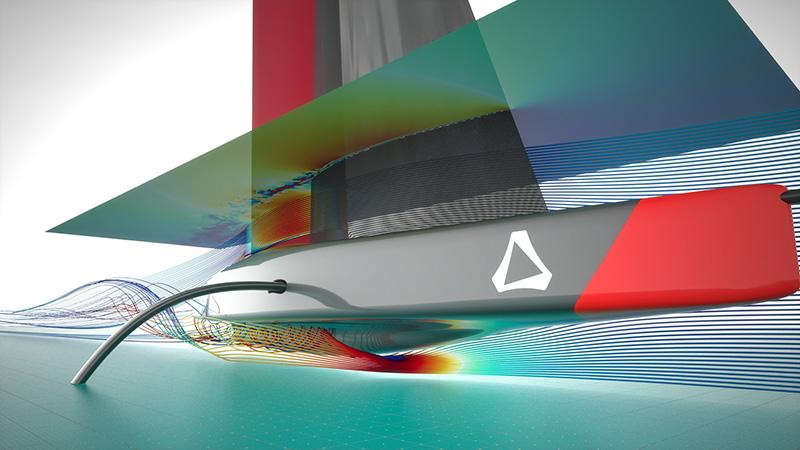
The new rules for the 2029 America’s Cup in Naples have opened up new possibilities for hull design. Under the revised rules, competing teams have greater freedom to develop their own hull geometries, creating both new opportunities and new engineering challenges.
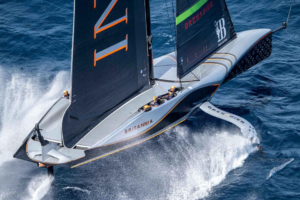
With the new rules, the design process is shifting from optimising an existing hull within a defined set of parameters to exploring entirely new hull geometries.
The America’s Cup is held every two years, and teams must also operate within strict budget caps.
So how can teams explore a much larger design space when time and resources are limited?
The British team GB1 has an answer: partnering with PhysicsX to use Physical AI in hull design.
01. The Three Pillars of PhysicsX
1. Large Geometry Models
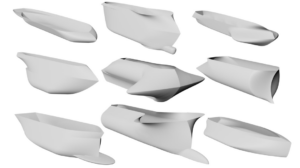
By learning patterns from vast amounts of 3D geometry data, large geometry models can generate new hull designs while accounting for engineering feasibility, competition rules and other design constraints. This enables a far broader exploration of the design space than conventional parameter-based optimisation.
2. Large Physics Models
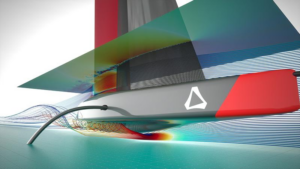
Large physics models learn the relationships between geometry and physical behaviour, enabling rapid performance predictions for candidate designs—potentially in seconds.
Engineers can use these predictions to screen large numbers of design candidates and identify the most promising options for further validation.
3. An Active Learning Loop
Active learning intelligently selects the designs most worth evaluating. These candidates are then assessed using high-fidelity computational fluid dynamics (CFD) simulations or engineering expertise, with the results fed back into the model to improve its predictive capabilities.
This closed-loop approach directs computational resources and engineering time towards the most valuable experiments, making the overall design process more efficient.
02. What Results Can This Approach Deliver?
The most immediate benefit is clear: exploring a much larger design space while reducing the need for high-fidelity simulations.
According to the reported results, the approach reduces the need for high-fidelity simulations by 80%.
For example, a workflow that previously required 5,000 CFD simulations could potentially achieve its objectives with just 1,000.
This represents a significant advantage for America’s Cup teams. With the budget cap set at €75 million for 2027, controlling engineering costs is critical. CFD simulation can be a substantial part of the development effort, so reducing the number of high-fidelity runs—or using the same resources to explore more design alternatives—could create meaningful opportunities to improve hull performance.
03. What Can We Learn from This?
There is no question that traditional simulation remains an essential engineering tool, grounded in the laws of physics.
AI is not replacing conventional simulation. Instead, it is changing how the engineering design process works.
A traditional engineering optimisation workflow typically follows this sequence:
Engineer proposes a design → Solver calculates its performance → Engineer analyses the results → Design is refined.
The approach that PhysicsX and GB1 are advancing introduces a more integrated, AI-driven workflow:
AI generates designs → AI predicts performance → Active learning selects the next candidates to explore → High-fidelity simulations validate the results → Models are updated and the process continues.
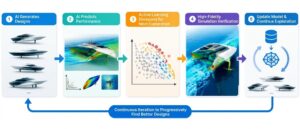
This is more than an improvement in computational speed. It represents a fundamental shift in the engineering design paradigm.
As a result, the competitive advantage of simulation software will increasingly extend beyond the solver itself. Data infrastructure, surrogate models, active learning, GPU acceleration, and integration with CAD, optimisation and experimental systems will all play a growing role.
The PhysicsX and GB1 collaboration offers a compelling example of how Physical AI can reshape engineering design—expanding what teams can explore, accelerating decision-making, and making better use of limited computational resources.