

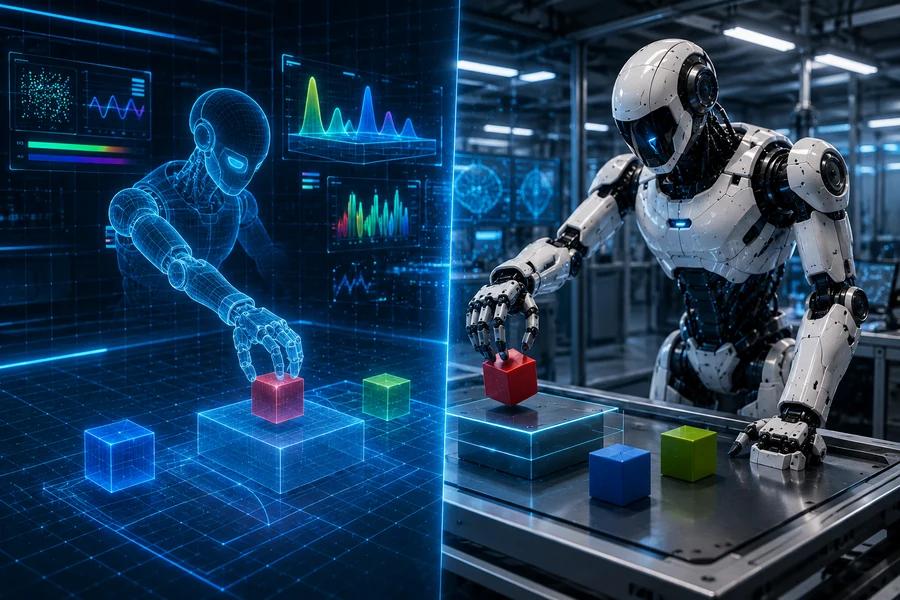
From video generation to real-world robotics, world models are emerging as a key concept in Physical AI. But can they truly help machines understand the physical world, or is the industry getting ahead of itself?
1. The News: World Models Move into the Physical AI Spotlight
World models are becoming one of the most talked-about concepts in artificial intelligence. Yet despite growing industry attention, the term remains loosely defined and is often used to describe a wide range of technologies, from video generation to robotic simulation and action planning.
The idea itself is far from new.
In 1943, cognitive scientist Kenneth Craik proposed that humans use “small-scale models” of reality to anticipate events and evaluate possible actions before responding to the world around them. This concept laid an early foundation for thinking about internal models of the physical environment.
In 2018, David Ha and Jürgen Schmidhuber published World Models, a landmark paper demonstrating how neural networks could learn compact representations of an environment and use them to predict its dynamics.
The field gained renewed momentum in 2024, as OpenAI introduced Sora and Google DeepMind unveiled Genie. These developments brought renewed attention to AI systems capable of generating and interacting with simulated environments, prompting researchers and companies across computer vision, reinforcement learning, generative AI and robotics to explore world-model approaches.
More recently, Fei-Fei Li and the World Labs team have contributed to the discussion around functional categories of world models, including renderers, simulators and planners.
The broader shift is clear: the conversation is moving beyond generating realistic images and videos toward building AI systems that can predict how environments change and how actions affect the physical world.

2. Why It Matters: From Visual Realism to Physical Understanding
Why is the industry paying so much attention to world models now?
Several technological developments are converging. Advances in computing, large-scale datasets and video generation have made it increasingly practical to train models on complex visual environments. At the same time, researchers are placing greater emphasis on controllability, temporal consistency and the prediction of physical interactions.
However, the real significance of world models extends beyond more realistic video generation.
A conventional language model can describe a cup falling off a table. A video generation model can produce a convincing visual sequence of the event. A world model, in its more ambitious form, aims to predict how the event unfolds under different conditions—and use those predictions to inform decisions.
Consider a robot facing a cup on a table.
If the robot gently pushes the cup from the left, the cup may slide toward the edge and fall. If the robot pushes from the opposite direction, the cup may move toward a nearby kettle instead, producing a different outcome.
Before acting, a capable world-model-based system could evaluate these alternative scenarios, estimate their consequences and select an appropriate action.
This involves more than predicting what the next frame will look like. It requires anticipating changes in object positions, contact interactions and potentially relevant physical consequences.
For robotics, this capability could help reduce trial and error, improve decision-making and make better use of simulation during training.
The potential impact is particularly significant for Physical AI: AI systems that perceive, reason about and act within the physical world, including robots, autonomous machines and other embodied systems.
In July 2026, World Labs announced its R2S2R simulation engine, described as an effort to connect simulation-based training with real-world robot deployment. If the reported capabilities translate into robust performance outside simulated environments, this type of development could help narrow one of robotics’ most persistent gaps: the difference between success in simulation and success in the real world.
3. The Industry Perspective: What Makes a World Model?
At a conceptual level, a world model gives an AI system an internal representation of how its environment behaves. Rather than simply identifying objects or generating plausible visual sequences, it aims to predict how the environment may evolve in response to different actions.
One useful way to understand this approach is to distinguish three complementary functions:
Renderer — Turning predictions into visual representations
A renderer converts predicted states or simulated outcomes into images, videos or other visual representations. It helps people and downstream systems inspect what a predicted scenario might look like.
Simulator — Predicting how the world evolves
A simulator estimates how the environment changes over time, given its current state and a potential action. Depending on the system, this may include object movement, contact events and other physical interactions.
Planner — Choosing what to do next
A planner evaluates possible actions using predicted outcomes. It compares alternatives against a goal, constraints or a measure of risk, then selects an action or sequence of actions.
Together, these functions can support a loop of prediction, evaluation and action.
It is important to note that these categories describe functional roles rather than a universal architecture. A renderer does not necessarily provide physically accurate simulation, and a model that predicts plausible future frames does not automatically possess reliable physical reasoning. In practice, the capabilities of different systems vary considerably.
This distinction also explains why world models should not be treated as synonymous with AI video generation.
A video model may produce a visually impressive scene in which a cup falls from a table. Yet the cup might pass through the tabletop, remain suspended in midair or behave inconsistently when the initial conditions change.
A world model intended for physical interaction must go further. Its predictions should respond appropriately when the robot changes the direction, force or timing of an action. The resulting trajectories and interactions should also remain sufficiently consistent with the underlying environment to support useful decisions.
For robotics, visual realism is valuable—but predictive reliability and action-conditioned consistency are what make a model useful for control and planning.
4. The Bigger Question: Breakthrough or Bubble?
Despite the promise, important challenges remain.
Physical environments are complex, and small prediction errors can accumulate over time. Models may struggle with unfamiliar objects, unexpected contact events or changes in lighting, materials and environmental conditions. Training data, computational cost, inference speed and the transfer of learned behaviour from simulation to real hardware all remain important considerations.
A world model that generates convincing videos is not necessarily a model that can safely guide a robot. Likewise, a successful simulation does not guarantee reliable real-world deployment.
The key question is therefore not simply whether world models can generate realistic environments. It is whether they can make accurate, useful predictions that improve decisions and translate into measurable performance gains in real-world tasks.
If they can, world models could become an important foundation for Physical AI, enabling robots to anticipate consequences before acting rather than relying primarily on repeated physical trials.
If they cannot, the industry risks conflating visual plausibility with physical understanding—and overestimating how quickly progress in generative AI can translate into practical robotics.
The future of world models will depend less on the popularity of the term and more on evidence of reliable prediction, effective planning and successful deployment.
What do you think is the biggest barrier to scaling Physical AI today: data availability, hardware limitations, model reliability, or deployment cost?